










Introduction
You buy a new set of innerwear. It fits at purchase. Three weeks later it is at the back of the drawer.
The waistband marked your skin by evening. The fabric felt wrong by 2 PM in the heat. The leg opening dug in. Nothing about the product page predicted any of this.
The photos showed a clean, well-fitting panty in a pleasant colour.
The description said soft and comfortable. You had no reason to expect otherwise.
This is the consistent experience with women's innerwear in India because the details that determine daily comfort are construction details, and construction details are almost never visible in product photography or clearly stated in listings..
Here is what actually matters and how to find it before you buy.
The Gusset: The Most Critical Detail Nobody Talks About
The gusset is the fabric panel in the crotch of the panty. It is the single most important construction detail in women's innerwear and the one most consistently compromised in affordable and mass-market products.
The reason it matters so much: the gusset is in direct contact with the most sensitive and moisture-sensitive area of your body for the full duration of wear. The material choice at this layer determines breathability, moisture management, and hygiene in a way that no other fabric decision in the garment matches.
The standard: a cotton inner layer at the gusset, regardless of what the outer fabric of the panty is made from. Cotton breathes. It manages moisture. In Indian summer heat, it stays comfortable at hour 12 where a synthetic inner layer creates a hot, damp environment against sensitive skin from hour four onwards.
How to verify before buying: search the product description for the words "cotton gusset," "cotton-lined gusset," or "gusset lining." These terms appear in product listings when a brand has made this construction decision deliberately. If none of these terms appear, the gusset lining may be synthetic.
Freecultr's women's innerwear includes a cotton-lined gusset on every style: brief, hipster, thong, and boyshort. This applies to cotton-modal styles, bamboo styles, and performance fabric styles equally.
The Waistband: Why It Leaves Marks and How to Avoid It
Waistband marks are not an innerwear size problem. They are a waistband construction problem.
A narrow elastic waistband, under 1.5 cm wide, concentrates its holding pressure into a thin line across the hip. Wear it for 10 hours and that pressure creates a visible mark in your skin. It also has a tendency to roll inward under fitted clothing, which requires repeated readjustment.
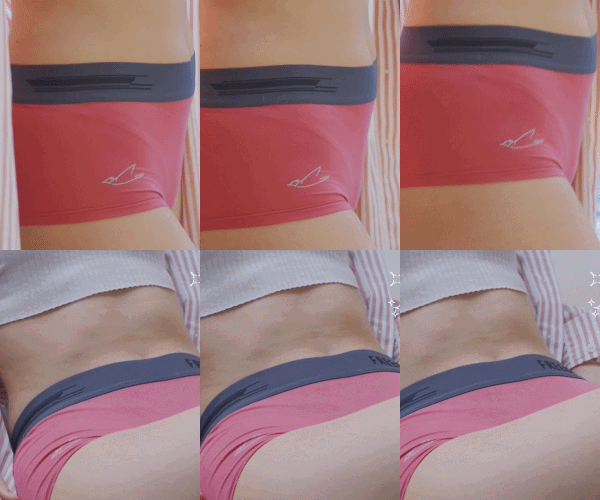
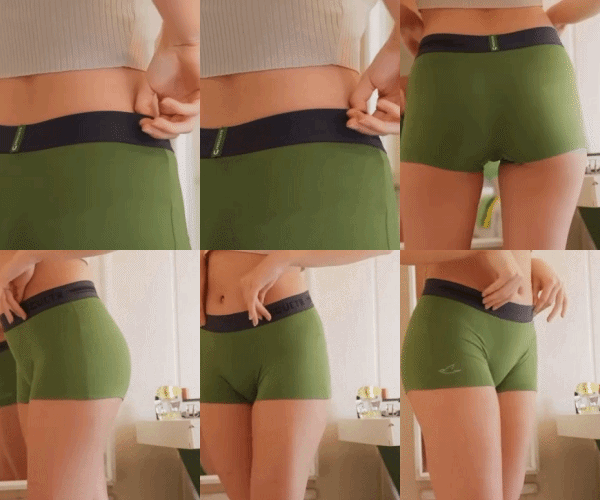
The construction that solves this is a covered fold-over waistband. The elastic sits inside a soft fabric casing. The contact against your skin is fabric rather than rubber. The width is 2 cm or more, distributing pressure across a broader surface. This waistband holds its position all day, does not roll, and leaves no marks.
You can identify this in product photos. A covered fold-over waistband looks soft and wide at the top edge of the panty. A narrow elastic waistband looks thin and clearly elastic. The difference is visible when you know what you are looking at.
A secondary check: does the brand mention waistband width in centimetres in the product specs? Brands that engineer for all-day comfort publish this. Brands that do not engineer for it typically do not mention it.
The Fabric: What "Breathable" Actually Means in Indian Heat
Product listings describe almost every innerwear fabric as breathable. In Indian summer conditions, that word covers a very wide range of actual performance.
True breathability in 35 to 40-degree humidity means the fabric moves moisture away from the skin rather than absorbing and holding it. Standard cotton absorbs moisture well but holds it against the skin. In a climate-controlled office that is adequate. On a commute in June humidity that becomes uncomfortable by the time you arrive.
The fabrics that genuinely manage moisture in Indian conditions:
Bamboo viscose wicks moisture through the fabric, is soft enough for sensitive skin, and has natural antimicrobial properties through bamboo kun that extend freshness through a long day. The right choice for summer daily wear and for women with sensitive skin.
Cotton-modal blend wicks more effectively than pure cotton because of modal's moisture-transport properties, while keeping cotton's durability and natural feel. More forgiving to wash than pure bamboo fabric. The right all-rounder for Indian daily wear.
Micromodal is the softest available fabric in innerwear. It manages moisture better than cotton but not as effectively as bamboo or cotton-modal blends in high-heat conditions. The right choice for cool environments or long desk days where sweat is not the primary concern.
Nylon-spandex is for active use specifically. It moves the most moisture fastest and dries quickest. It is less comfortable for passive daily wear than natural fibre blends. Use it for gym wear and running, not all-day office wear.
Leg Opening Finish: The Detail That Determines Visible Lines and Friction
The leg opening of a panty determines two things: whether it creates visible panty lines under fitted clothing, and whether it causes friction marks on the inner thigh during a long wear day.
Standard elastic leg openings create a visible ridge through fitted fabric and can cut into the skin at the inner thigh fold, especially during sitting. Two better options exist.
Soft-touch silicone border elastic sits flatter against the skin than standard elastic and reduces the visible edge under clothing. It is durable and works across fabric types.
Seamless edge finishing removes the distinct border entirely. The fabric thins at the leg opening rather than ending with any elastic or seam. This is the closest to invisible under clothing and the softest against the inner thigh. It is the right choice for women who regularly wear fitted dresses, leggings, or trousers.
A Quick Checklist for Buying Women's Innerwear Online
Before completing any online innerwear purchase, confirm five things from the product listing:
- Does the description explicitly mention a cotton or cotton-lined gusset?
- Does the product photo show a wide, softly finished waistband rather than a narrow elastic strip?
- Is the fabric composition listed with enough detail to identify the fibre blend and elastane percentage?
- Does the size chart show actual hip measurements in centimetres, not just S/M/L labels?
- Is the leg opening finish (standard elastic, soft-touch, or seamless) mentioned or visible in the photos?
A listing that answers all five is giving you the information needed to make an informed decision. A listing that answers none of these is hiding behind photography and vague copy.
Fabric by Lifestyle: Matching Your Innerwear to Your Day
| Your Typical Day | Recommended Fabric | Why |
|---|---|---|
| Office, mostly sitting, climate-controlled | Micromodal or cotton-modal | Maximum softness, adequate breathability |
| Mixed: commute, office, evening out | Cotton-modal blend | Handles all three without failing at any |
| Outdoor commute, high heat, humid city | Bamboo viscose | Wicks moisture, resists odour, stays comfortable |
| Gym, running, high-sweat activity | Nylon-spandex with cotton gusset | Maximum moisture management for active use |
| Sensitive skin, prone to irritation | Bamboo viscose or micromodal | Finest fibres, softest against skin |
copy.
Conclusion
Innerwear for women covers panties, bras, bralettes, shapewear, camisoles, and innerwear sets.
Panties in particular are worn against the most sensitive skin on your body for 12 to 16 hours a day, every day.
The fabric and construction decisions made during manufacture are with you for every hour of every day you wear the product.
They deserve more than a quick glance at a product photo
Frequently Asked Questions
What fabric is best for women's innerwear in Indian summer?
Bamboo viscose is the strongest performer in Indian summer conditions for daily wear. It wicks moisture away from the skin rather than absorbing it like cotton, and bamboo kun gives it natural antimicrobial properties that keep fabric fresh longer between washes. Cotton-modal blend is a close second and more forgiving to wash. Both outperform pure cotton in high heat and high humidity. For gym and running specifically, nylon-spandex moves the most moisture fastest, but it requires a cotton gusset lining and is less comfortable for all-day passive wear.
Why does my underwear waistband leave marks on my skin?
Marks come from a narrow elastic waistband concentrating pressure into a thin line against the hip. The fix is a covered fold-over waistband minimum 2 cm wide, where the elastic is inside a fabric casing rather than directly against your skin. Also check sizing: if the waistband sits with tension rather than resting flat, sizing up resolves part of the marking. Both the construction and the fit contribute. Freecultr's women's innerwear uses a covered fold-over waistband across all styles.
How do I find the right size in women's innerwear online?
Measure your hip circumference at the fullest point, parallel to the floor. This is the primary sizing measurement for brief, hipster, and boyshort cuts. For high-rise and full-brief styles, also measure your natural waist at the narrowest point. Compare both numbers against the brand's specific published size chart, not a generic guide or your trouser size. When between sizes, go up. A slightly generous panty is comfortable; a slightly tight one is not, and the discomfort increases over the course of a long wear day.
What is the difference between seamless women's innerwear and regular innerwear?
Seamless innerwear is constructed without traditional sewn seams at leg openings and side seams, using knitting or bonding techniques that produce smooth, thin edges. The practical result is no visible panty lines under fitted clothing and no friction ridge at the inner thigh. Regular innerwear has sewn seam edges that are more durable but create a visible ridge through fitted fabric. Seamless edge finishing (where only the leg opening is seamless but the rest of the garment is constructed normally) is a middle option that provides the no-show leg edge without the production complexity of fully seamless construction.
Is it worth paying more for premium women's innerwear brands in India?
Yes, when the premium is based on fabric and construction rather than just a label. A Rs 450 bamboo viscose panty that is comfortable for 12 hours and lasts 50 washes costs less per day of comfortable wear than a Rs 120 panty that becomes uncomfortable by afternoon and loses its shape after 15 washes. The key is verifying that the premium brand is using the construction decisions that justify the price: cotton-lined gusset, covered waistband, quality fabric blend with sufficient elastane. Freecultr's women's innerwear ranges from Rs 299 to Rs 549 per piece depending on fabric, with combo pack pricing bringing the per-piece cost to Rs 220 to Rs 400. -e